Holiday Lights: Electric Bill Cost and Cord Safety
A worked example puts one LED string at about 34 cents and an incandescent string at about $3.38 for 240 hours, plus government limits on cords.
- Rate used
- 35.224 cents per kWh (Eversource, Eastern MA) or 40.014 cents (National Grid), supply plus delivery, per DOER
- Example, LED
- 4 watts, 0.96 kWh, about $0.34 (Eversource) or $0.38 (National Grid)
- Example, incandescent
- 40 watts, 9.6 kWh, about $3.38 (Eversource) or $3.84 (National Grid)
- Cord limit
- CPSC: no more than three standard-size sets per extension cord
- Outdoors
- Outdoor-rated lights and cords, plugged into a GFCI outlet
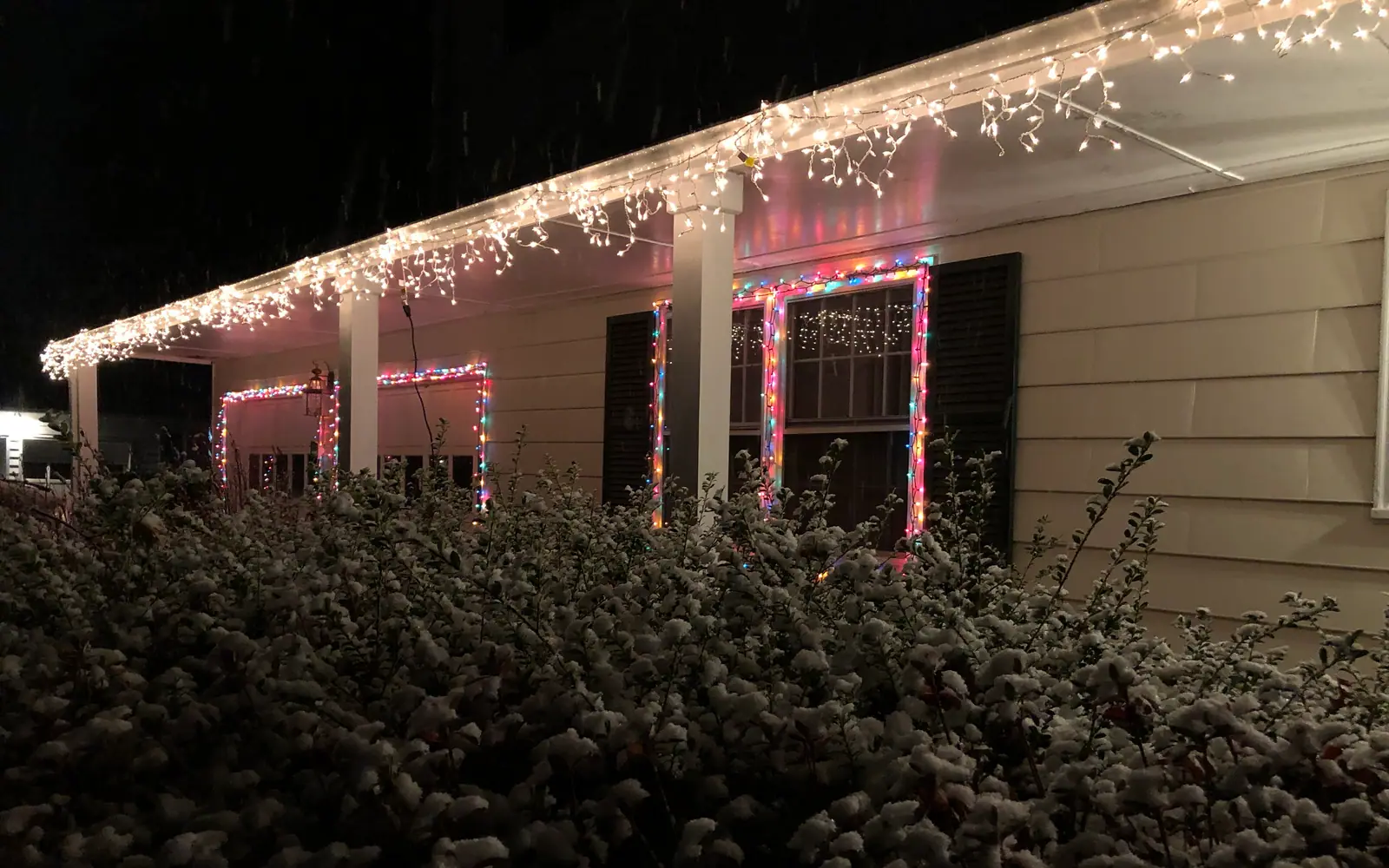
A 100-bulb string of LED mini lights costs roughly 34 cents to run for 240 hours at Eversource’s current electric rate, and a 100-bulb incandescent string costs roughly $3.38, using the Department of Energy’s wattage figures. This is a worked example under stated assumptions, not a bill. Checked November 14, 2026.
The inputs, and where they come from
Wattage. A 2003 Department of Energy report, prepared for its Building Technologies Program, puts the average miniature incandescent lamp at 0.4 watts and an LED mini lamp at 0.04 watts, which it calls 90% less. It assumes a 100-lamp strand. That makes 100 x 0.4 = 40 watts for the incandescent string and 100 x 0.04 = 4 watts for the LED string. These figures are more than twenty years old, so use the wattage printed on your own package if it differs. A separate Energy.gov article from December 2015 says LEDs use 70 percent less energy than conventional incandescent strands, and gives $0.27 to light a 6-foot tree for 12 hours a day for 40 days with LEDs, against $10 for incandescent.
Hours. The same DOE report assumed 5 hours a day for 30 days, or 150 hours a year. This example uses 6 hours a day for 40 days, or 240 hours, and shows the 150-hour case too. These are assumptions, not measurements of your house.
Rate. The cents-per-kWh figures come from the state’s heating guide, the same source as our winter electric rates guide. They combine supply and delivery and leave out the fixed monthly customer charge. If your electricity comes from a municipal light plant, swap in that plant’s rate. If you buy from a town program or competitive supplier, your supply portion differs.
Worked example, step by step
The formula is: watts x hours / 1,000 = kWh, then kWh x rate = cost.
One 100-bulb incandescent string, 240 hours
- 40 watts x 240 hours = 9,600 watt-hours.
- 9,600 / 1,000 = 9.6 kWh.
- At Eversource’s 35.224 cents: 9.6 x $0.35224 = $3.38.
- At National Grid’s 40.014 cents: 9.6 x $0.40014 = $3.84.
One 100-bulb LED string, 240 hours
- 4 watts x 240 hours = 960 watt-hours.
- 960 / 1,000 = 0.96 kWh.
- At Eversource: 0.96 x $0.35224 = $0.34.
- At National Grid: 0.96 x $0.40014 = $0.38.
| Scenario | Incandescent, Eversource | LED, Eversource | Incandescent, National Grid | LED, National Grid |
|---|---|---|---|---|
| 240 hours | $3.38 | $0.34 | $3.84 | $0.38 |
| 150 hours (DOE’s assumption) | $2.11 | $0.21 | $2.40 | $0.24 |
Ten identical strings multiply every figure by ten, so ten incandescent strings at 240 hours would run about $33.82 at Eversource’s rate against about $3.38 for ten LED strings. Large displays, timers and different bulb sizes change the numbers. Check the wattage on each package.
Cords, outlets and how many strings to connect
The sources below do not set one universal number for strings joined end to end, and the Massachusetts Department of Fire Services tells residents to follow the manufacturer’s instructions and safety information. What the government sources do say:
- Extension cords. The U.S. Consumer Product Safety Commission’s November 30, 2001 release says to use no more than three standard-size sets of lights per single extension cord, to use only lights with fused plugs, and to make sure the cord is rated for its use. That is an older release, so treat it as a conservative ceiling and defer to the label on your own sets.
- Overloading. Mass.gov’s electrical fire safety page says not to overload outlets and not to run cords under rugs or pinched behind furniture.
- Check each set. The CPSC’s 2017 advice and the State Fire Marshal’s December 10, 2025 release both say to inspect lights for damage. The Fire Marshal says to check for cracks, pinches and wear and discard damaged strings.
- Tested lights. The Fire Marshal says to choose lights listed by an independent testing laboratory like UL or Intertek/ETL.
- Replacement bulbs. CPSC says to replace burned-out bulbs promptly with the same wattage.
- Outdoors. CPSC says to check labels that outdoor lights are certified for outdoor use and to plug them only into a GFCI-protected receptacle or a portable GFCI. The Fire Marshal says lights and extension cords should both be rated for outdoor use and plugged into a Ground Fault Circuit Interrupter outlet.
- LEDs and load. The DOE report notes that LEDs draw 90% less current, which makes lights run together or on extension cords safer because of lower power use.
Safety around trees, candles and space heaters is in our fire safety guide, and when to put the tree out is in the Christmas tree pickup guide.
Checked November 14, 2026 against the sources listed below.
Get home guides like this by email
Winter prep, rebates and the practical chores, one useful guide at a time.
Free bonus when you join: the printable December plan. Unsubscribe in one click.
Sources
- DOE: Energy Savings Estimates of Light Emitting Diodes in Niche Lighting Applications (2003)www1.eere.energy.gov
- Energy.gov: How Do Holiday Lights Work?energy.gov
- Mass.gov DOER: A Guide to Household Heating Costs in Massachusettsmass.gov
- CPSC: CPSC Releases Holiday Decoration Safety Tips for Avoiding Fires and Injuries (2001)cpsc.gov
- CPSC: Put Safety at the Top of Your List When Decorating this Holiday Season (2017)cpsc.gov
- Mass.gov DFS: State Fire Marshal Reminds Residents of Christmas Tree Fire Hazards (December 10, 2025)mass.gov
- Mass.gov DFS: Electrical Fire Safetymass.gov
Details such as dates, hours and prices come from the sources above and can change. Check with the organizer before you go.
How we report: every date, price and address comes from a linked source.


